Showing posts with label science. Show all posts

Monday, June 03, 2013

If you get there last, leave a message

There's a scene in Three Little Pigskins where Moe and Larry are arranging to meet at a predetermined location:
Moe: If you get there first, put a chalk mark.
Larry: Okay. What if you get there first?
Moe: Then I’ll rub it out.1
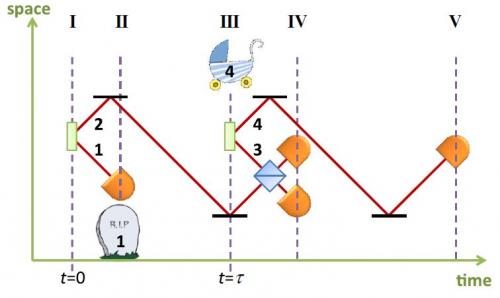
Anyway, The Reg reports that scientists have done this, only better, sending a message from one photon to another that that was already deceased.
Measuring P1 destroys it; even so, it gets its state from P4
Image: Phys. Rev. Lett. 110, 210403 (2013)
DOI: 10.1103/PhysRevLett.110.210403
1The Marx Brothers may have done this first, but I can't locate the scene.

Thursday, February 07, 2013

More on science

Three quick notes on the ways that science making our lives, um, interesting.
  • We've often heard that printer ink is more expensive than human blood. Well, here's a twist: UK scientists have used 3D printers to print human stem cells. It's within the realm of imagination that we could eventually use human blood in printers to make something beyond our imaginations.
  • Humans have had a problematic relationship with insects. Some, such as honey bees, do great things for us. Mosquitoes are frog food and carry deadly diseases. We've done battle with chemicals and bazookas.
    Well, insects are fighting back and they've got robots.
  • Fish are in schools but, until science showed up, they could never raise their hands when the have an answer to the teacher's question. The Register reports that Fish grow ‘hands’ in genetic experiment.

    Fish testing at Alden Research Lab

One of a occasional series. A bunch of years ago, I worked for a software company. It was hard work for long hours. At one point, senior management made the pronouncement that the development team needed to focus more on a particular aspect of the product. The QA manager and I agreed that we'd Focused More-ons.

Thursday, January 31, 2013

Citizen science: to observe and record

How do you talk to your kids about big hard subjects? You talk to them. Then, you give them something to do about it.
Kids know and feel a lot about troubles in the world. They might not always know the details of the problem, but they know something isn't right. They might think it funny at first that a shipment of yellow rubber ducks fell off a freighter and is adrift in the Pacific. Then they realize that not all trash in the water is cute. Most of it is ugly and all of it can make us sick.
So what do you do? Well, for one thing, you can send them to the water's edge and have them count pieces of debris along with thousands of other folks around the world who are part of the International Coastal Cleanup project. Each year, volunteers walk their coasts and up trash. Before they toss it in the receptacle, however, they record what they've found. Cigarette butts, plastic bags, shotgun shells and casings, cars, and appliances. (You can see the full data set here.)
The ICC project lets kids of all ages do something not only to clean up our messes, but also contribute to scientists' research into our oceans. These most basic skills, to observe and record, form the foundation of all scientific research. This is work that's done by citizens. Dr. Loree Burns, writes in her third book, "Citizen science, then, is the study of our world by the people who live in it." Her book is Citizen Scientists: Be a Part of Scientific Discovery from Your Own Backyard.
Learning from litter
Dr. Burns talked to a dozen of us in meeting room at the Wachusett Meadows Audubon Sanctuary the other night. She tells her story easily, of graduate studies in biochemistry, the ways that kids push our lives in directions we'd not planned or even thought possible, and, as noted earlier, the challenges of talking to kids about big and sometimes troubling ideas.
So when she read a brief article Dr. Curt  Ebbesmeyer, an oceanographer who was tracking debris, including rubber duckies, that was riding the Pacific currents, she saw a way to continue with her scientific work and, at the same kids, keep kids like hers, and such as hers, busy with meaningful projects. That became book the first, Tracking Trash.
Is Mom killing the honey bees?
Her second book, The Hive Detectives, takes readers on an investigation to find out what's killing the honey bees.
At one point during the research cycle, the media misreported that bees were hypersensitive to cellphone radiation as well as chemicals we use in our yards and farms. The kids heard those stories as well. When the kids saw their mom using her cellphone, they panicked for bit.
Yes, the radiation may not be good for the bees, but one phone call, by itself, isn't going to destroy a hive. A lot of factors go into the colony collapses. "There's not one thing responsible for the death of the honey bees," said Dr. Loree.
Rarely does science tie things up nicely and put them in a box. Maybe there are seven factors contributing to an outcome that we don't like; maybe there are 70. If we eliminate or reduce two or 10, will that make enough of a difference.
We're not sure.
You know what? Kids are OK with that. They can work the ambiguities as long as they know their work is making a difference somehow.
Ladybugs are carnivorous.
The Lost Ladybug Project is part of the work to find out why certain types of ladybugs were increasingly difficult to find. Professor John Losey is an etymologist  at Cornell, researching ladybugs. Through field work with his young son, Ben, he discovered that children could be valuable research assistants. So valuable, in fact, that two Virginia siblings, age 10 and 11, found the first nine-spotted ladybugs seen in eastern North America in 14 years.
Ladybugs, by the way, eat aphids, making them a favorite for farmers. Ladybugs, by all accounts, don't like the taste of humans of any age.
What if you don't have a backyard?
We talk about our world as if it's universal when, in fact, its only the world that we see. When Dr. Loree talked to a group of kids in an urban school, they were puzzled at the thought of looking for anything in a backyard. Outdoors was often dangerous.
It turns out that you can raise sunflowers and other plants in a window box, the flowers of which can attract bees, even in the city. We may think of nature as only existing in the countryside. In a world increasingly urban, nature follows us. It looks different, but it's still nature and it still needs scientists.
Kids pay attention to what we do and how we do it.
If we, as adults, are afraid because we don't have the answers or afraid of the answers we've found, kids will notice. They're not always looking for a definitive answer. They're looking for ways of dealing with all this stuff, dealing with change, dealing with things that aren't going well, that are scary. If we can show them how to understand problems by observing and recording, they might not feel so helpless. They've got something to do that part of something bigger than themselves.
When we figure that out, for ourselves as well as for the kids, we get better, too. That's how it is that Dr. Loree can say, as she did at the end of the presentation the other night, "There's a piece of this that is, for me, just joy."
Sunday, December 02, 2012

How to get a window seat on the bus

I'll be seeing some friends from high school this week. As we swap stories, sometimes we forget if events happened to us or someone else. It's a bit like the bats in the Pogo comic strip, Bewitched, Bothered and Bemildred, who often forgot who was whom.

Anyway, ...

Our junior high science teacher wanted us to study nature. For our spring project, we were to collect 25 different types of bugs. A couple of boys asked if we could go fishing, instead. She agreed. One fish would equal five bugs.

I caught a couple of fish, probably a kivver and a perch, because those were the most easily caught at the camp. Matched up with the 15 bugs, I turned in my specimens and left them in the science project room.

We hadn't thought this all the way through.. Within a day, the science project room equaled the gym locker room for odor and on the second day it won.

I tried throwing away the shoe box containing my project, but the janitor made me take it out of the trash bin and bring it home.

It was a 45-minute ride on the school bus. I had no trouble getting a seat for myself by a window.

Wednesday, July 04, 2012

Bring it on, space alien h@k3rz. We've got the DMCA.

Even though researchers are worried that signals captured by search for extraterrestrial intelligence (SETI) might carry a virus-laden payload, we're getting even in the best way that we know how. We've put copyright-protected music and text on the interstellar missionary Voyager.


Saturday, July 31, 2010

Science- the cause and cure of all of our problems

In these days of modern times, many aspects of life get complicated. You learn things, wonder about things, read things. It makes sense for a while, then it does, then it does again.
For example, in the "Do you guys read what the other guys wrote?" department, we learn that scientists can genetically modify bacteria to accelerate the production of biofuel.  Sounds pretty much kinda good, I guess, until you read a bit further and learn that the host bacterium is a new strain of Escherichia coli, "chosen because it breeds readily in laboratory conditions and so is a good candidate for industrial-scale processes."
Uh, huh. We know this bacterium by its colloquial name, E. coli. This stuff - Emerging E. coli strain causes many antimicrobial-resistant infections in US.
Granted, these are different strains of bacteria. You wouldn't want to assume that each is as dangerous as the other. It's like, well, I'm sure that we'll come up with a metaphor that'll make us comfortable with the idea that E. coli. is going to lead us to energy independence.

Thursday, April 08, 2010

What the noises of the night are telling us

Last week, Sandra's cousin posted a note about the peepers in Virginia.
New sound today: frogs. About a month back, there were Spring Peepers.  I missed them this year because of the foul weather and blocked trail when they were singing.
...
Several weeks later in the season, the singers in the same swamp are different frogs.  They don’t “peep” as much as bellow.  They proclaim the coming of a warmer season, very assertively.  And it’s easier to have real faith on an 80° afternoon.

Our peepers showed up last week as the result of the warm late winter/early spring and the rains that churned the waters' edges. During the last couple of nights, I've heard crickety kinds of things. (Friend Dr. Loree might appreciate my use of the scientific terms here.) It would be wonderful if the frogs made a strong return. I remember that great sound on warm evenings. The last couple of decades, however, haven't been kind to frogs in northeast, an indicator that the waters aren't as pure as they used to be and need to be.
My concern is that this might presage a hot summer. My tribe has the tradition of responding to heat by jumping into water that's as much as 100°C colder. As you might expect, our responses to excessive heat aren't always the brightest.
Even the farmers are suspecting that we're going to have a warm spring that will lead to early crops.  Today's Telegram has a front page story, Growing concern, about the apple growers who are as much as a month ahead of their usual schedule. The farmers are now waiting for the bees to do their business, bees that Dr. Loree has discussed in her book, The Hive Detectives: Chronicle of a Honey Bee Catastrophe.
So, the night sounds and silences are trying to tell us something. As with most stuff, we'll  figure it out some time after we need to have figured it out.

Blog Archive