Showing posts with label history. Show all posts

Friday, April 26, 2013

The alpha and omega of the web

Twenty years ago, the Mosaic web browser was released into the wild. There'd been earlier browsers used by Sir Tim and others, but Mosaic was, to many, their first glimpse of what the web had to offer.
The Register marks this milestone with a brief history and a few tests of Mosaic 1.0 against the modern web. (Imagine a 1963 36-HP VW Beetle on the Mass Pike.)
Mosaic was my first browser. We had to compile it ourselves from a kit that we downloaded from the University of Illinois servers. It ran on the DEC workstations, both VMS and, if I recall correctly, Ultrix (DEC's versions of UNIX).
There wasn't a lot of content at that time, mostly engineering documents and related geekery. Nevertheless, you could follow a trail of links from morning to night. The most famous coffee pot in the world, the one in the Trojan Room at the University of Cambridge came to the web later in 1993.
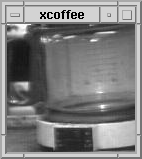
The Trojan Room Coffee Pot
From then until now, we've heard every breathless, hyperbolic phrase used to describe how the web and its communications underpinnings are ushering a new era of human existence. Those ejaculators are probably right, at least in part.
After all, look how far we've come, from a program that allowed nuclear scientists to share research to a video of a cat in a shark costume, sitting on a Roomba, chasing a duckling, with a dog in another shark costume in a stellar cameo performance.

Thursday, April 18, 2013

A sense of place

Americans are an unsettled people. Census records  (PDF) show that a third to nearly half of us moved at least once in the previous five years. The period 2005-2010 showed the lowest rate,  35.4 percent, in the past 40 years.
Geographical Mobility: 2005 to 2010

Even though the unemployed have a higher mobility rate than the general population, the  collapse of home prices seems to have kept people in place. Most moves, when they do take place, occur within the same county.
We still like to keep in touch. A study of our phone call patterns shows how frequently we call people within certain regions.
The Connected States of America
Worcester makes a lot of calls within the Northeast, but has surprisingly strong phone connections to Florida and southern California and Arizona.
Americans aren't the only ones to move, to shake off our past and plot our futures. A hundred years ago, we had a time of singular convergence. Although there's no record that they ever met, we learn from a BBC story that Hitler, Trotsky, Tito, Freud and Stalin lived in Vienna.
BBC -- 1913: When Hitler, Trotsky, Tito, Freud and Stalin all lived in the same place
None of them was born in Vienna and all changed their names before making the 20th century.

Sunday, March 31, 2013

Thomas Jefferson and Easter

Through a series of cut-and-paste, although mostly cut, Thomas Jefferson created a copy of the Bible that made sense to him. You can read more about Jefferson's editing in the Smithsonian article, How Thomas Jefferson Created His Own Bible.
The Life and Morals of Jesus of Nazareth collects the Gospels into a cohesive narrative, attempting to put the events into chronological order and leaving out those things that are “contrary to reason.”
As a result, the book ends with a part of John 19:31ff and then a pasted piece of Matthew 27:60:

There laid they Jesus, and ... rolled a great stone to the door of the sepulchre, and departed.


Jesus died. They put Him in the tomb and walked away. No resurrection.

Thursday, April 22, 2010

Exporting American cool

It takes a world of nerds to fill the minds of nerds with stuff that they didn't know that they wanted to know.
OK, so our lives would probably have been fulfilled even if we didn't get a chance to read about the guy who pioneered the ice trade.
Nevertheless, this article, The Forgotten American Ice Trade, from a blog in India by way of Hacker News | American Ice Trade, in its substance, shows how an entrepreneur built an industry of ice shipments from Boston to the India that Columbus thought he'd found and, eventually, to the India that really was.
By the methods of the 'net, we get to feel that same burst of connectedness and opportunity. It's doubtful that I would have sought out an article about the ice trade, much less tried to research the topic. Further, I read Hacker News because, as the name implies, it provides a stream of mostly technical topics. Somewhere on the line, some nerd found this article and posted it; other nerds found it interesting.

Blog Archive