Showing posts with label education. Show all posts

Saturday, November 09, 2013

Rethinking school size

In our efforts to reduce class sizes in schools, we are missing a more important metric.
Son Adam noted years ago in his school safety findings that there's correlation between school size and school safety. A smaller school is more likely to be a safer school, irrespective of other factors in the community.
Researchers have published a working paper that shows this and other benefits of smaller schools in New York City.
Regionalization has been in use in Massachusetts for nearly 60 years. The goals was to save on administrative costs and make programs available to students who would not have had access in small-town schools. We're now seeing that the benefits of this consolidation weren't quite as grand as we'd hoped.

h/t Freakonomics

Saturday, June 01, 2013

On Google maps and education

At lunch today, I talked with a former professor about some of the issues that he sees with his students. This, by the way, is at Amherst. The students who get in there did so because they knew how to present themselves to their high school teachers and admissions boards. They knew how to win.
Many student wrote papers that were focused on a narrow topic, crisply-defined, but with little connection to other ideas or domains. These students did well well because they showed a clear answer to a specific, albeit esoteric, question. Their research skills were limited to delivering a precise answer with no ragged edges.
If you ask Google Maps (or any GPS system) for turn-by-turn directions, you get good results. Using those directions will get you where you intend to go, but with a curious side effect. You are delivered as in a tunnel, without context.
Time was, we studied maps and knew not only the path, but also the frame of reference. Recently, I had to travel to a part of a nearby town that was unfamiliar to me. The person I was visiting said that his street is right near the so-and-so school. I used Google Navigation. It made no mention of the school as a prominent reference point. Instead, it said, "in 600 feet,  turn left." I got where I was going, but Google told me nothing of the fact that this family lived near a school.
It turned out that living near a school was very relevant to this person and his wife because his kids could walk to school. Google told me what was true, but not what was meaningful.

Tuesday, April 02, 2013

Educational merry-go-round

Bill Cosby talked about how the grown-ups "improved" the playground by adding monkey bars and other malevolent inventions that were deemed fun for kids. He vowed never to play on any playground equipment that he didn't see adults using.
He tried the merry-go-round once. "You sit on it and three of your friends push you around in a circle for five minutes and then you throw up."
I was talking with a middle-school student recently. She said that she likes math but is terrified of the upcoming MCAS test.
Tracy Novick recently blogged that sixty percent of adults failed a Rhode Island math test required for high school graduation.
If testing is such a good way to prove that we're competent, why don't adults have to re-take the graduation exams to prove that they still deserve their diplomas and degrees? Why do we put kids on rides that we won't use ourselves?

Friday, March 29, 2013

Educational conferences and Spotted Dick

The Brits have a dessert that's tasteless in both senses of the word. Spotted Dick is, according to various sources, a boiled suet pudding with raisins or currants stuck to the outside. Serving the delicacy with custard doesn't help much. It's best to eat the sweet, dried fruit and then look for the dog to finish the rest.
I've been to a few educational conferences in the past three months. They, too, have had some sweet treats in a flavorless puddle. The good parts are real and exciting; the boiled suet is soul-crushing.
The conferences have had these general characteristics:

  • There are excruciatingly few questions from the audience. Most of the few questions are the teacher-equivalent of "Will this be on the test?" The educators ask about logistics and process, rather than digging deeper into the ideas. 
  • Even the good presenters often aren't interested in talking afterwards. They're good on stage, but have a tough time with individuals and small groups. 
  • The Twitter stream and other social media channels are quiet. Some of this depends on conference organizers. If' they promote it online, more people respond. Otherwise, there's little chatter inside the room and even less from people outside.
  • If the people at the conferences are the innovators or interested in innovation, imagine the dispirited temperaments of those who didn't attend. We should be worried about the future of education. 
We also need to make sure that the catering staff (mostly students) checks their spelling before lunch.

Thursday, January 31, 2013

Citizen science: to observe and record

How do you talk to your kids about big hard subjects? You talk to them. Then, you give them something to do about it.
Kids know and feel a lot about troubles in the world. They might not always know the details of the problem, but they know something isn't right. They might think it funny at first that a shipment of yellow rubber ducks fell off a freighter and is adrift in the Pacific. Then they realize that not all trash in the water is cute. Most of it is ugly and all of it can make us sick.
So what do you do? Well, for one thing, you can send them to the water's edge and have them count pieces of debris along with thousands of other folks around the world who are part of the International Coastal Cleanup project. Each year, volunteers walk their coasts and up trash. Before they toss it in the receptacle, however, they record what they've found. Cigarette butts, plastic bags, shotgun shells and casings, cars, and appliances. (You can see the full data set here.)
The ICC project lets kids of all ages do something not only to clean up our messes, but also contribute to scientists' research into our oceans. These most basic skills, to observe and record, form the foundation of all scientific research. This is work that's done by citizens. Dr. Loree Burns, writes in her third book, "Citizen science, then, is the study of our world by the people who live in it." Her book is Citizen Scientists: Be a Part of Scientific Discovery from Your Own Backyard.
Learning from litter
Dr. Burns talked to a dozen of us in meeting room at the Wachusett Meadows Audubon Sanctuary the other night. She tells her story easily, of graduate studies in biochemistry, the ways that kids push our lives in directions we'd not planned or even thought possible, and, as noted earlier, the challenges of talking to kids about big and sometimes troubling ideas.
So when she read a brief article Dr. Curt  Ebbesmeyer, an oceanographer who was tracking debris, including rubber duckies, that was riding the Pacific currents, she saw a way to continue with her scientific work and, at the same kids, keep kids like hers, and such as hers, busy with meaningful projects. That became book the first, Tracking Trash.
Is Mom killing the honey bees?
Her second book, The Hive Detectives, takes readers on an investigation to find out what's killing the honey bees.
At one point during the research cycle, the media misreported that bees were hypersensitive to cellphone radiation as well as chemicals we use in our yards and farms. The kids heard those stories as well. When the kids saw their mom using her cellphone, they panicked for bit.
Yes, the radiation may not be good for the bees, but one phone call, by itself, isn't going to destroy a hive. A lot of factors go into the colony collapses. "There's not one thing responsible for the death of the honey bees," said Dr. Loree.
Rarely does science tie things up nicely and put them in a box. Maybe there are seven factors contributing to an outcome that we don't like; maybe there are 70. If we eliminate or reduce two or 10, will that make enough of a difference.
We're not sure.
You know what? Kids are OK with that. They can work the ambiguities as long as they know their work is making a difference somehow.
Ladybugs are carnivorous.
The Lost Ladybug Project is part of the work to find out why certain types of ladybugs were increasingly difficult to find. Professor John Losey is an etymologist  at Cornell, researching ladybugs. Through field work with his young son, Ben, he discovered that children could be valuable research assistants. So valuable, in fact, that two Virginia siblings, age 10 and 11, found the first nine-spotted ladybugs seen in eastern North America in 14 years.
Ladybugs, by the way, eat aphids, making them a favorite for farmers. Ladybugs, by all accounts, don't like the taste of humans of any age.
What if you don't have a backyard?
We talk about our world as if it's universal when, in fact, its only the world that we see. When Dr. Loree talked to a group of kids in an urban school, they were puzzled at the thought of looking for anything in a backyard. Outdoors was often dangerous.
It turns out that you can raise sunflowers and other plants in a window box, the flowers of which can attract bees, even in the city. We may think of nature as only existing in the countryside. In a world increasingly urban, nature follows us. It looks different, but it's still nature and it still needs scientists.
Kids pay attention to what we do and how we do it.
If we, as adults, are afraid because we don't have the answers or afraid of the answers we've found, kids will notice. They're not always looking for a definitive answer. They're looking for ways of dealing with all this stuff, dealing with change, dealing with things that aren't going well, that are scary. If we can show them how to understand problems by observing and recording, they might not feel so helpless. They've got something to do that part of something bigger than themselves.
When we figure that out, for ourselves as well as for the kids, we get better, too. That's how it is that Dr. Loree can say, as she did at the end of the presentation the other night, "There's a piece of this that is, for me, just joy."

Tuesday, January 22, 2013

Abbreviated education

UMass offers online undergraduate and graduate programs. To learn about the programs, you need to fill out a form and select the program(s) that interest you before you can download a brochure.
The form lists several programs, including some with long names that are truncated by the form window. Too bad. I was wondering what a degree in Education Specialist Degree in Curriculum and I might encompass.

But, wait, there's more. If you view the source of the page, you can see the full description of the programs. You also see, but without explanation, that the form page starts with 147 blank lines.
If you stumble around the site, you can also find out more about the programs on their Programs page.

Monday, January 21, 2013

Technology in education - are the roads wide enough?

Last week's Technology in Education conference left me with a couple of ideas to ponder:
  1. There are a lot of good people on the front lines of education, teachers and administrators. They have the smarts and commitment to do great things. They're creating lots of small successes, even in small, rural school district where bandwidth and access to computers remains an issue.
  2. During the morning sessions, including the keynote and two workshops, no one asked a question or made a comment. (One person did ask for clarification about the location of some materials, but there were no questions about the content.) Attendees at the afternoon sessions talked more. 
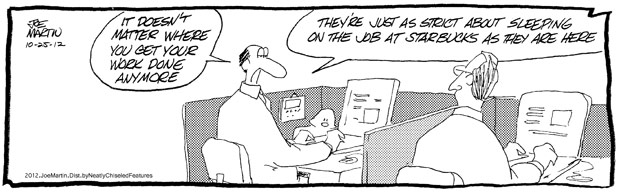
In 2007, ABC News ran a story, The Future of the Workplace: No Office, about the changing world of work. More than 40% of IBM's employees don't have a full-time office in an IBM facility. They work from home, customer sites, hotel rooms, airplanes, or, occasionally, an IBM office that's set up to support visiting workers.
While K-16 (kindergarten through college) education brings lots of money and attention on science, technology, engineering, and mathematics, the STEM curriculum, little is said about the way that people work.Collaborating with teams around the country or the world requires much more intentional communication. You can't rely on corridor conversations to exchange ideas or schedule changes. You can't keep your project plan on a whiteboard in the main conference room.
via Mr. Boffo Archives
The people from the Lower Pioneer Valley Educational Collaborative included the ABC story in their presentation. After their talk, I asked the presenters how well educators understood the ways in which work has changed and will change even more. They said that there was little evidence of widespread appreciation of this type of change. Teachers and parents were OK with the new content included in STEM education, but weren't seeing a need for learning about new ways to work.
Teaching new material in traditional ways fits well, in my opinion, with an educational model that lines up with standardized tests as the measure of educational success. Teaching old or new content in new ways may not.
Watching a couple hundred people sitting and listening to ideas about radically reinventing education is unsettling. It reminds me of my classes in the 60s, where a radical history professor would be spouting revolution and the students in the back of the classroom wondered if the Yippies were going to be on the mid-term.
Every airplane carries a black box (which isn't really black, but orange so that it can be found easily after a crash) that contains recording devices that stores vital data and voice recordings.
Do you know why they don't make airplanes the same way that they use in the black boxes? Because the roads aren't wide enough.
(A plane built like that wouldn't get off the ground and would have to drive to its destination.)
Educators are keenly aware that they're measured by the kids' test scores. Federal and state funding is tied to improvements in the numbers. Change has to be introduced carefully, lest it disrupt what's already proved to work well enough. 
Added to that is an academic environment for educators that rewards obfuscation in language and thought.
The result is a risk-averse spirit that wraps innovation in thick protective layers.
The entrepreneurial spirit that we expect of our kids when they go to work is punished when applied to education. Entrepreneurs know that  meaningful failures are essential to eventual success. An essential element of physical and emotional well-being is resilience, the ability to adapt to change and setbacks and find new ways to move forward.
For the many people in politics and in the general public who don't like government or educators, lower test score means that schools are failing again. Never mind that the lowered scores might be the result of incompetence or an experiment that didn't turn out as hoped. The remedies for each type of failure are quite different.
Marco Annunziata is Chief Economist and executive director of Global Market Insight for GE. reported on on GE's annual Innovation Barometer. More 300 global business leaders who were surveyed said that they want governments to cultivate more innovation in education to prepare students for often chaotic work that's ahead. One respondent endorsed "strengthening the education system in a way that not only gives students a solid basis of knowledge, but also fuels an entrepreneurial culture and creates a closer alignment with business. "
This new world of work is less than a generation old. We don't yet have proven methods for educating large numbers of students in the technologies and processes that will be a part of their lives.  We need to try some things, many of which may not work. No one likes the idea of experimenting on our kids. Truth be told, however, I don't think we have much choice. We're not going to get them to their future by driving down I-91 in a jet. 

Friday, September 14, 2012

Learning by getting it wrong

While writing a blog for another site, I wanted to use the metaphor of the old Nickel-Cadmium (NiCd) battery memory effect problem. For those of you who remember the early portable devices, such as Sony's Discman, they used NiCd batteries. We were warned through the documentation and our friends that we should always completely drain the battery before recharging. Otherwise, the battery would lose its ability to charge fully and develop a memory for a certain charge level, sometimes called a set point.

I wanted to allude to the fact that people can develop this set point as well, losing the ability to learn only so much, which was far less than what their original capacity would indicate.

Upon further research, I learned that the memory effect wasn't really there. It was mostly about the behavior of cheap chargers and the perception, not the fact, that the battery wasn't fully charged. The explanation is nicely summed up in Dan's Quick Guide to Memory Effect, You Idiots.

The metaphor works even better. People can learn, even when their brains appear to be over-full or when they appear to be not fully open to change. It may look as though they aren't learning and can't use the knowledge. Our perceptions of the way that others learn is, in part, what's faulty, as well as the charging (educational) system.

NiCd batteries are hazardous waste. I don't know where that fits into the metaphor.

Wednesday, August 08, 2012

More on education and marketing

Online course and textbook company Kno announced that it is offering a line of K-12 textbooks. The materials are available for the iPad and web browsers. Native Windows and Android apps are in the queue.

Kno has partnered with Houghton Mifflin Harcourt, one of the major textbook publishers in the world. If you browse over to the HMH web site on your iPad (because you want to see how things look), you can find the catalog for each grade and subject area:

If you click Browse, you can see what they have to offer:

Flash doesn't run on an iPad. It also does not run on Android, so that you can't browse the catalog from your Android phone or tablet.

This is not an auspicious beginning for Kno.

Friday, February 17, 2012

More on law schools and job prospects

The latest in the War on Law Schools comes in the form of a Tennessee student who said that her law school was negligent because they admitted her to the school. Because she hadn't completed her undergraduate work, she won't be eligible to take the bar exam, get a job as a lawyer, and eventually shed nearly $80K in student loans.

A few thoughts on this:

Further, claiming that you aren't qualified and that it's your school's fault may not be a great career-building strategy. 

Friday, November 11, 2011

More on education and politics

[caption id="attachment_2836" align="alignright" width="300" caption="Tim Connolly and Rep. Jim McGovern"][/caption]

The other day, Rep. Jim McGovern spoke at our WISE politics and media class. Tim Connolly, communications director for Worcester County D.A. Joseph Early, Jr., is leading the class. McGovern took questions for the full 90 minutes. As you might expect, topics ranged widely from Worcester politics to the pile of rubble that is the Washington political process. "If you wanted to chose any time in history to be president," said McGovern, "this is not the time you would choose." (Ref The Onion's on-point headline in November 2008, Black Man Given Nation's Worst Job .)

We talked redistricting. More than half of his district is new to him, now anchored to the west by Amherst and Northampton. (I corrected him on the pronunciation of Amherst, with a silent h. The townspeople notice such things.) The discussion about education included the usual topics of improving STEM (Science, Technology, Engineering, and Mathematics) as we try to prepare young people for jobs in the emerging green economy and medical technology.

In a bit of topic drift, we noted that a 20% turnout, coupled with Joe Perry's 48% plurality, means than fewer than 10% of Worcester voters chose their new mayor. "We are ultimately responsible for whom we elect," noted McGovern. By comparison, 40% of Fitchburg electorate voted. They re-elected Lisa Wong as mayor.

In addition to the usual concerns about civic detachment, the class agreed that civics should also be included in any education reform.

I know that it's comparing apples and dump trucks to relate my personal educational experiences with the practices and people of these times. There are a few dynamics about growing up, however, that are somewhat enduring. So, here are a couple of points:

  • I loved history, social studies, and political science. I even got an award as best social studies student in my graduating class. My first college course, taken when I was 16, was political science. I grew up in a household where both parents voted regularly, where my mother campaigned for Ed Brooke as senator.
    I didn't vote until I was 30.

  • There were several classes - Shakespeare in freshman English, shop, and gym, notably - that caused me not only not to learn the subjects but also to hate them later in life. Part of it was bad teaching, more of it was due to an inept student forced to display his ineptitude for the world to see.


These are notes of caution about what we can expect from education of any type, be it our public schools or even a parent to a child. We can give skills and knowledge, knowing that some of that will land on fertile ground and some will land on the rocks. The skill of the teacher and the aptitude of the student are the major factors here.

Much, much harder, though, it teaching people how to care when they don't. Even if we can identify root causes and remove those impediments, our successes are less than hoped for. It's pretty easy for people who are passionate about a topic to share why they're excited. The stories that are most interesting and, I think, most instructive, are the ones where someone once didn't care and now does. What happened? Is there anything transferable from those life lessons?

I voted for the first time because I was friends with people who were active in politics and who voted. The friendship preceded the act of voting. (This, by the way, is why social networks can be so compelling.) It's not about trust in the political arena or in the classroom, perhaps, but in the coffee shops and living rooms and other social places, where change happens. I voted not because I trusted the politicians so much as I trusted my friends.

Friday, June 03, 2011

More on education

The good teachers, though, helped me not only learn new material, but also how to learn. They taught me to read better, glue a bunch of ideas into a new framework, and then write better.
You'd think, with all of the time that I've spent in college classrooms, I would have figured out what parts of education lead to success and what is a waste of time and money. I'm guessing that you'd think that, because I know that I do.
I can identify a half dozen great teachers, professors who knew their material very well and were able to engage me so that I became excited about learning what they knew. Most of the others are deservedly unmemorable.
So, how come an academic career in the liberal arts led to a career in high tech? Until the time that it happened (and for long while afterwards), no one would have predicted it.
Recently, our thinking about the relationship between cholesterol and heart disease was upended. Researchers verified that raising HDL (good cholesterol) levels made no difference in the progression of heart disease in patients who started out with low HDL levels. People with low HDL typically are more likely to have heart disease, but raising their HDL doesn't help them much.
We can correlate a factor with a condition, but changing that factor doesn't affect the outcome of the condition.
Data suggest antidepressants score slightly ahead of placebos, A doctor prescribes antidepressants, but only one patient in eight will do better with the medication than with a placebo. And, theplacebos are getting stronger.
Our ability to predict who will benefit from something is slightly better than doing nothing, but telling them we're doing something. For example, psychologist Ellen Langer showed that telling people that they were living a healthy lifestyle could result in the people acting that way. 
It's long been a given that people with more education tend to be happier, wealthier, and healthier. (Your mileage, of course, will vary.)  It appears that we can get more people to college by expanding opportunities at community colleges, graduate programs, and for-profit institutions. And what happens?
  • Law students have discovered that their new law degrees will leave them with massive amounts of nondischargeable debt. On that realization, they are suing a law school for leading them to believe that law school was a good deal. It almost amounts to Promissory estoppel, inducing someone to do something based on implication.
  • New federal regulations will require that for-profit educational programs yield “gainful employment.’’  
  • Venture Capitalist Peter Thiel recently awarded two dozen $100K grants to students who chose to leave college to do real work.
It appears that we've identified many factors to happiness, wealth, and happiness. Some of the factors, such as race, gender, family size, and birth order are, once set, pretty much immutable. Others can change by individual effort and societal support, such as education, physical appearance, opportunity for work, and on-going support. Still others are governed by luck, good or bad, at certain times.
Even if we can identify the factors for success, our efforts don't have success that rise much above chance outcomes.
Personally, I'm surprisingly at peace with this. Most of the stuff that I predicted for my life didn't come true; most of the time it's been better than I'd expected. The things that went wrong, well, some came with valuable life lessons, and some were just wrong and have stayed broken. More on that another time.

More on education

The good teachers, though, helped me not only learn new material, but also how to learn. They taught me to read better, glue a bunch of ideas into a new framework, and then write better.
You'd think, with all of the time that I've spent in college classrooms, I would have figured out what parts of education lead to success and what is a waste of time and money. I'm guessing that you'd think that, because I know that I do.
I can identify a half dozen great teachers, professors who knew their material very well and were able to engage me so that I became excited about learning what they knew. Most of the others are deservedly unmemorable.
So, how come an academic career in the liberal arts led to a career in high tech? Until the time that it happened (and for long while afterwards), no one would have predicted it.
Recently, our thinking about the relationship between cholesterol and heart disease was upended. Researchers verified that raising HDL (good cholesterol) levels made no difference in the progression of heart disease in patients who started out with low HDL levels. People with low HDL typically are more likely to have heart disease, but raising their HDL doesn't help them much.
We can correlate a factor with a condition, but changing that factor doesn't affect the outcome of the condition.
Data suggest antidepressants score slightly ahead of placebos, A doctor prescribes antidepressants, but only one patient in eight will do better with the medication than with a placebo. And, theplacebos are getting stronger.
Our ability to predict who will benefit from something is slightly better than doing nothing, but telling them we're doing something. For example, psychologist Ellen Langer showed that telling people that they were living a healthy lifestyle could result in the people acting that way. 
It's long been a given that people with more education tend to be happier, wealthier, and healthier. (Your mileage, of course, will vary.)  It appears that we can get more people to college by expanding opportunities at community colleges, graduate programs, and for-profit institutions. And what happens?
  • Law students have discovered that their new law degrees will leave them with massive amounts of nondischargeable debt. On that realization, they are suing a law school for leading them to believe that law school was a good deal. It almost amounts to Promissory estoppel, inducing someone to do something based on implication.
  • New federal regulations will require that for-profit educational programs yield “gainful employment.’’  
  • Venture Capitalist Peter Thiel recently awarded two dozen $100K grants to students who chose to leave college to do real work.
It appears that we've identified many factors to happiness, wealth, and happiness. Some of the factors, such as race, gender, family size, and birth order are, once set, pretty much immutable. Others can change by individual effort and societal support, such as education, physical appearance, opportunity for work, and on-going support. Still others are governed by luck, good or bad, at certain times.
Even if we can identify the factors for success, our efforts don't have success that rise much above chance outcomes.
Personally, I'm surprisingly at peace with this. Most of the stuff that I predicted for my life didn't come true; most of the time it's been better than I'd expected. The things that went wrong, well, some came with valuable life lessons, and some were just wrong and have stayed broken. More on that another time.

Blog Archive