Saturday, May 11, 2013

Reading by Kindle light

For the second time this week, we lost power. It was earlier in the evening this time, about 5:30. We listened for our neighbor's generator. Sure enough, the low hum was rolling across the cove.
Ours is such an exciting life. Friday evenings are anchored by several PBS shows (Newshour, Beat the Press, This Old House) plus a couple of items on DVR. As a half hour became an hour, we set ourselves up for a different time.
We heard the sounds of the Northern toads in the swamp, a long, low call offered to potential mates. We had a round of checkers. Sandra won two of three. We had our supper on the deck by the sauna and lingered until the black flies and early mosquitoes drove us away.
The dark filled the house and eventually the outdoors. We could see our neighbor's flag, waving in an easterly breeze. The hour became two. We read for a while, Sandra on her iPad, me on the Kindle. At nine, we went to bed.
I'm usually awake a couple of times during the night, for an hour or two each time. I woke at midnight, read for a while, went back to sleep, and got up again shortly before three.
National Grid, our electric company, has a website that let's you check on the status of outages in an area. Cell phone coverage at the camp is faint, barely 1 bar.
(National Grid uses Amazon Web Services, AWS, to handle its outage map.)
Sitting by the window and with the phone high, I waited and eventually collected enough bits from the sky to get to the website and learn about the state of things.
As I was reviewing the information, the WiFi signal icon came on. Odd. I looked at the floor and noticed that the lights on one of the power strips was on. The power was restored an hour earlier than estimated.
Dunno what happened. My guess is that a transformer blew out, affecting a small part of a small town. I stayed up for a while longer, drifting off at first light.

Friday, May 10, 2013

VZW giveth, taketh away

When we watch British detective shows on TV, I regularly marvel at the quality of cell phone coverage available to all. They can be in the catacombs of some office building, out in the barrens and moors, or on the North Sea coast. The cell phone rings. They talk.
Around here, and certainly at the cove, an unaided phone struggles to gain one bar of 1G service. Verizon, AT&T, and Sprint all have the same reception. Other folks in the lake may fare better, given the variability of terrain and the amount of granite between their locations and their carrier's towers.
With a MiFi gadget from Verizon, we could get passable Internet connections, provided that the receiver was set in the proper location, high on a north-facing wall.
Last year, we tried something different, a network extender from Verizon. The device sits on a window sill and fetches the faint signal from the tower over the hill, just enough to make the connection. The rest of the call is routed through our cable Internet service (Comcast).
It works well. All calls are clear and steady. Occasionally, we'll miss a call and it will go straight to voicemail.   Sometimes, the GPS setting is way off. My phone may report that I'm in  Gloucester. (When we use it in Holden, the location can show up as Cambridge.) Overall, though, we've been pleased with the performance. It's more than paid for itself.
That we need it at all is a point left for another discussion, having to do with the way that our national telecommunications policies have built an expensive, inefficient, and unreliable wireless system. (Imagine if you could drive your car only on certain highways; to drive on others, you'd have to change cars.)
Mark Gibbs writes in Forbes about several dubious features in the way that Verizon has implemented this much-needed product:

  • Even though calls are routed through my Internet service from Comcast, Verizon charges me for the minutes and/or data that I use over the extender. The data shouldn't be an issue (I hope), because I use WiFi connections on my phone. 
  • Any Verizon Wireless customer can connect to the network extender.It would be more of a concern if we lived in a more densely-populated area. The nearest neighbor is more than 150m away.  In theory, someone fishing just offshore might be able to connect and make calls.
    It's possible to give priority to selected numbers, but there's no way to whitelist just the phones in the household. 
AT&T. and Sprint have network extenders You can restrict access to certain phones to use them. Verizon has delivered a product that makes their bad coverage better, but manages to dent that outcome with bad policies. 

Wednesday, May 08, 2013

For that special mother in your life


Light by sound

We lost power this evening for nearly an hour and half. To confirm that it wasn't just us, we stepped outside and heard the sound of our neighbors' generator. It kicks on automatically and can run for a long time on propane.
A rain shower had come through, but no thunder. I called the electric company and learned that it wasn't a widespread outage. A crew was on the way, but they weren't sure how long it would take to get us back online.
There was enough light for a brief walk around the cove. In case you're wondering, the mosquitoes are here and hungry. In the damp air as the darkness filled the woods, they found us delicious. We made our way along the dirt roads and paths. At each turn, we could hear the low hum of the generator and knew the power was still off.
Our neighbor, a retired dentist who served in the Korean War, has a flag in front of his house. He keeps a light on the flag all the time, even on generator power. Now at twilight, the flag stood bright and strong.
We returned from our walk and settled in to whatever it is that people do when there's no electricity. Sandra lit the hurricane lamp and we talked. In time, the lights came back. Outside, across the cove, our neighbor's flag waves gently in the quiet light.

Sunday, May 05, 2013

One spring morning at the cove


There was no wind last night, so the cold fell straight from the clear sky onto our fair settlement.

It was in the low 50s inside the camp when Dame Judi decided that it was time for the household to rise and shine and give her her breakfast.
We had one of our earliest first saunas last night. We have a lot of spruce pieces left over from the construction project two years ago. Spruce burns hot and fast and pops loudly. The aches of the day's work softened and soon were gone. 
A month ago, the ice was still thick in the cove. Our first dip was tentative and brief. The second lasted a minute or two. There were a couple of guys fishing nearby.
"You got a sauna in there?" one of them asked.
"Yep," I replied, neck deep in the water. "We'd be even crazier otherwise."
The camp came through the winter in good shape. We lost one tree, a hemlock, just a week ago. It snapped about eight feet from the ground and fell sideways in the front yard.
It had been dead for awhile, likely because of the Hemlock Woolly Adelgid, and should have been culled when we had the tree guys here last year.
All the other trees look ok, but it's still early. The maples, birches, and oaks are still two or more weeks away from full foliage. 
Our neighbors visited yesterday afternoon, reporting on their winter and plans for the summer. At their shore, they'd been scolded by a male duck that had been protecting his mate. We later saw both ducks touring the cove.
In the evening, after sauna and supper, Sandra went outside and identified the sound of the Northern spring peeper in the vernal stream nearby. Our project this season, among others, is to listen to and catalog peepers and then frogs
It's that transition time, when something of what you need is at the other place. We have a list of things that we forgot to bring yesterday. Let's hope that we remember the list when we go into town today.
We've had our breakfast and our second cup of coffee. It's time to split wood for this evening's fire. 

Thursday, May 02, 2013

If there is a ride back, it'll be all downhill.

Their summer project will be to ride 750 miles into a headwind  from sea level to 9000 ft. where, on a good day, the Centigrade and Fahrenheit scales converge.  These guys are planning to ride bikes to the South Pole.
The South Pole Epic
They're raising money on Kickstarter. If you pledge $75, you can get a t-shirt.

Friday, April 26, 2013

The alpha and omega of the web

Twenty years ago, the Mosaic web browser was released into the wild. There'd been earlier browsers used by Sir Tim and others, but Mosaic was, to many, their first glimpse of what the web had to offer.
The Register marks this milestone with a brief history and a few tests of Mosaic 1.0 against the modern web. (Imagine a 1963 36-HP VW Beetle on the Mass Pike.)
Mosaic was my first browser. We had to compile it ourselves from a kit that we downloaded from the University of Illinois servers. It ran on the DEC workstations, both VMS and, if I recall correctly, Ultrix (DEC's versions of UNIX).
There wasn't a lot of content at that time, mostly engineering documents and related geekery. Nevertheless, you could follow a trail of links from morning to night. The most famous coffee pot in the world, the one in the Trojan Room at the University of Cambridge came to the web later in 1993.
The Trojan Room Coffee Pot
From then until now, we've heard every breathless, hyperbolic phrase used to describe how the web and its communications underpinnings are ushering a new era of human existence. Those ejaculators are probably right, at least in part.
After all, look how far we've come, from a program that allowed nuclear scientists to share research to a video of a cat in a shark costume, sitting on a Roomba, chasing a duckling, with a dog in another shark costume in a stellar cameo performance.

Thursday, April 25, 2013

Ubuntu eats Windows driver

Each time I install Ubuntu on my Thinkpad T420S in a dual-boot configuration with Windows 7, the driver for my Ricoh multi-card reader goes missing. The error shows up as an error for "Base System Device in Device Manager.
The drivers for this device are not installed. (Code 28)
I tried re-installing several devices drivers that purport to handle this device. No joy.
The fix is to a) fix the MBR so Ubuntu isn't available or b) ?. After removing the dual boot configuration, there is no error.

Wednesday, April 24, 2013

Java hates users.

In preparation for a class that I'm teaching, I perform a Java update on my Windows 7 system. After avoiding the installation of the crapware Ask.com toolbar, I complete the installation.

A browser window opens up.
I click the button. Another window opens.
I click the link to resolve the problem. (Yes, the plug-in is enabled.)
I'm brought to a page where I can download and install the latest version of Java. Although I've just done that, by way of the update, I humor them and download and run the kit.
I'm rewarded with this:


My solution: I've uninstalled Java and refuse to use websites that require it.

Tuesday, April 23, 2013

We have the right to remain silent

Respecting Hakkarainen's Law of Great Events, this may be a good time not to read too much of what other people are posting on the Intertubes. Lots of people, including people I like, are saying things for, against, and "I was for it before I was against" last week's events in Boston. Much of what I've seen has been disappointing, both in what's been said and by whom it was said.
I certainly don't need to add to that pool of unhelpful commentary. (Ref. the corollary to HLGE.)

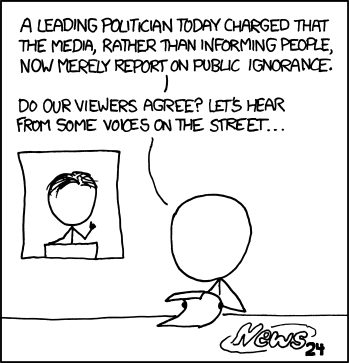
Published on the Friday before the world of Boston went a-scramble, this Guardian (UK) article shows that reading news is toxic to our minds and bodies. Among other things,
News inhibits thinking. Thinking requires concentration. Concentration requires uninterrupted time. News pieces are specifically engineered to interrupt you. They are like viruses that steal attention for their own purposes. News makes us shallow thinkers.
An Elvis impersonator sends ricin-laden envelopes to the President and members of the Senate.
via Google Trends on 4/22/13
The lethal mail doesn't even outpace news queries about the Kardashians. We're dealing with a news wave that's too big to ride, let alone analyze with any coherence.

Sunday, April 21, 2013

Happy Birthday, Adam

Adam (front) with Mike and lunch - PEI 

Thursday, April 18, 2013

Lenovo registration fail

Why, oh, why does Lenovo require a salutation for their products?


It's none of their frickin' business my gender, marital status, or profession.
Further, they get it wrong. In standard English usage, Miss is not an abbreviation.

A sense of place

Americans are an unsettled people. Census records  (PDF) show that a third to nearly half of us moved at least once in the previous five years. The period 2005-2010 showed the lowest rate,  35.4 percent, in the past 40 years.
Geographical Mobility: 2005 to 2010

Even though the unemployed have a higher mobility rate than the general population, the  collapse of home prices seems to have kept people in place. Most moves, when they do take place, occur within the same county.
We still like to keep in touch. A study of our phone call patterns shows how frequently we call people within certain regions.
The Connected States of America
Worcester makes a lot of calls within the Northeast, but has surprisingly strong phone connections to Florida and southern California and Arizona.
Americans aren't the only ones to move, to shake off our past and plot our futures. A hundred years ago, we had a time of singular convergence. Although there's no record that they ever met, we learn from a BBC story that Hitler, Trotsky, Tito, Freud and Stalin lived in Vienna.
BBC -- 1913: When Hitler, Trotsky, Tito, Freud and Stalin all lived in the same place
None of them was born in Vienna and all changed their names before making the 20th century.

Tuesday, April 16, 2013

The time is right

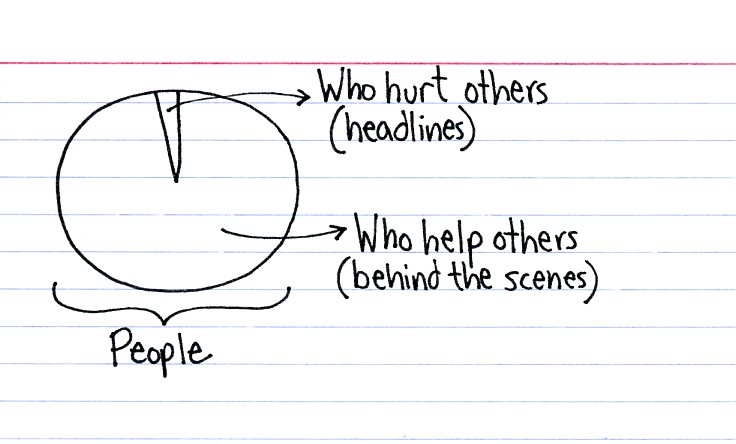
More than enough has already been said about yesterday's bombings with much more to come. While it's too early for us to know what it all will mean, it is the right time to reflect on the ways that good deflects evil.
For those who put themselves in harm's way for our sake.

Friday, April 12, 2013

More on passwords

When I went to BJ's  to create an online account, I dutifully created a password with at least eight characters, including at least one letter and one number. As standard practice, I also include a punctuation mark, making password cracking that much more difficult.
99.wharlG
BJ's took exception to my choice. but did so only with a suggestion.
If a password should only contain alphabets (sic) and numerics, (sic+1) etc., then I would still be permitted to use punctuation characters against their advice. Grumble, grumble.

One of an occasional series.
A bunch of years ago, I worked for a software company. It was hard work for long hours. At one point, senior management made the pronouncement that the development team needed to focus more on a particular aspect of the product. The QA manager and I agreed that we'd be Focused More-ons.

We wish you a Spammy Christmas. Please buy our watch.

It's the first Christmas sale of the the new year. Granted, the offer comes from a suspect source.

But, hey, even spammers need to get an early start.

Monday, April 08, 2013

Fading snow

With temps climbing into the 60s today, I decided to tempt fate and move the snow blower from the front yard to its summer place by the sheds. The last chunk of snow, well, really, ice, is almost gone from our deck.

The corner of our yard, sheltered from the sun, is still snow-covered. At the camp, there's still a foot or more of ice that's been pushed into the cove by the strong northwest winds.

I'm guessing that it will take at least a week, maybe even two, before the cove is open. We're still hoping to open up around the first of May.

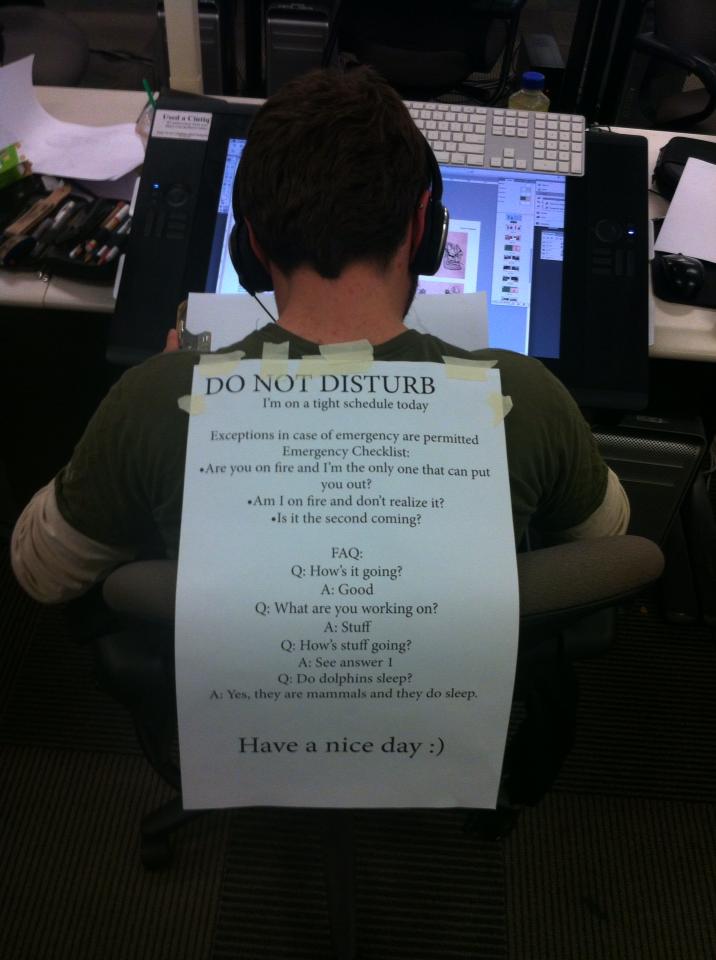
Undisturbed

When we worked in cubeland and needed concentrate, we'd often put up a virtual door across the cubicle entrance. The door was a long piece of masking tape with a Do Not Disturb sign stuck to it.
Some people don't even have a cubicle and so must become their own door.
via Boing Boing

Sunday, April 07, 2013

Best uses for old tech

You might not think that disk drives are obsolete. Increasingly, though, solid-state drives are replacing the types with spinning disks. The solid-state devices (SSDs) are faster, lighter, and consume less energy. SSDs are more expensive, but the other features outweigh the cost for sleek laptops.
In addition, you might have upgraded a desktop system, replacing an old drive with a higher-capacity one.
So, you've got an old disk drive sitting around. What can you do with it?
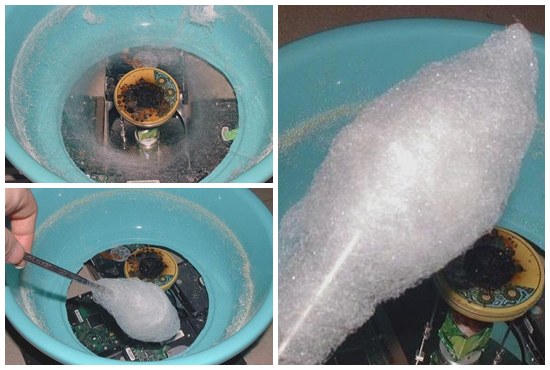
Make cotton candy, of course.
Turning an Old Hard Disk Into a Candy Floss Machine
John C. Wharton, a candy maker, and William J. Morrison, a dentist, received a patent in 1899 for "certain new and useful improvements in candy machines." (US Patent # 618,428). This bit of hackery builds on that patent with modern tech and spare parts.
via LifeHacker

One of an occasional series of best uses and reuses for old computer gear and related stuff.

Blog Archive